
Patriot Docks kit guide
Floating Dock Size and Layout: How to Plan Your Kit
Water depth first, then deck height, side floats, length and shape: how to pick the Patriot kit that fits your stock tank, pond or lake.
By Shoreline ProductsUpdated 7 min readChecked against Patriot Docks Floating Dock Assembly Instructions, 2026 edition
The short answer
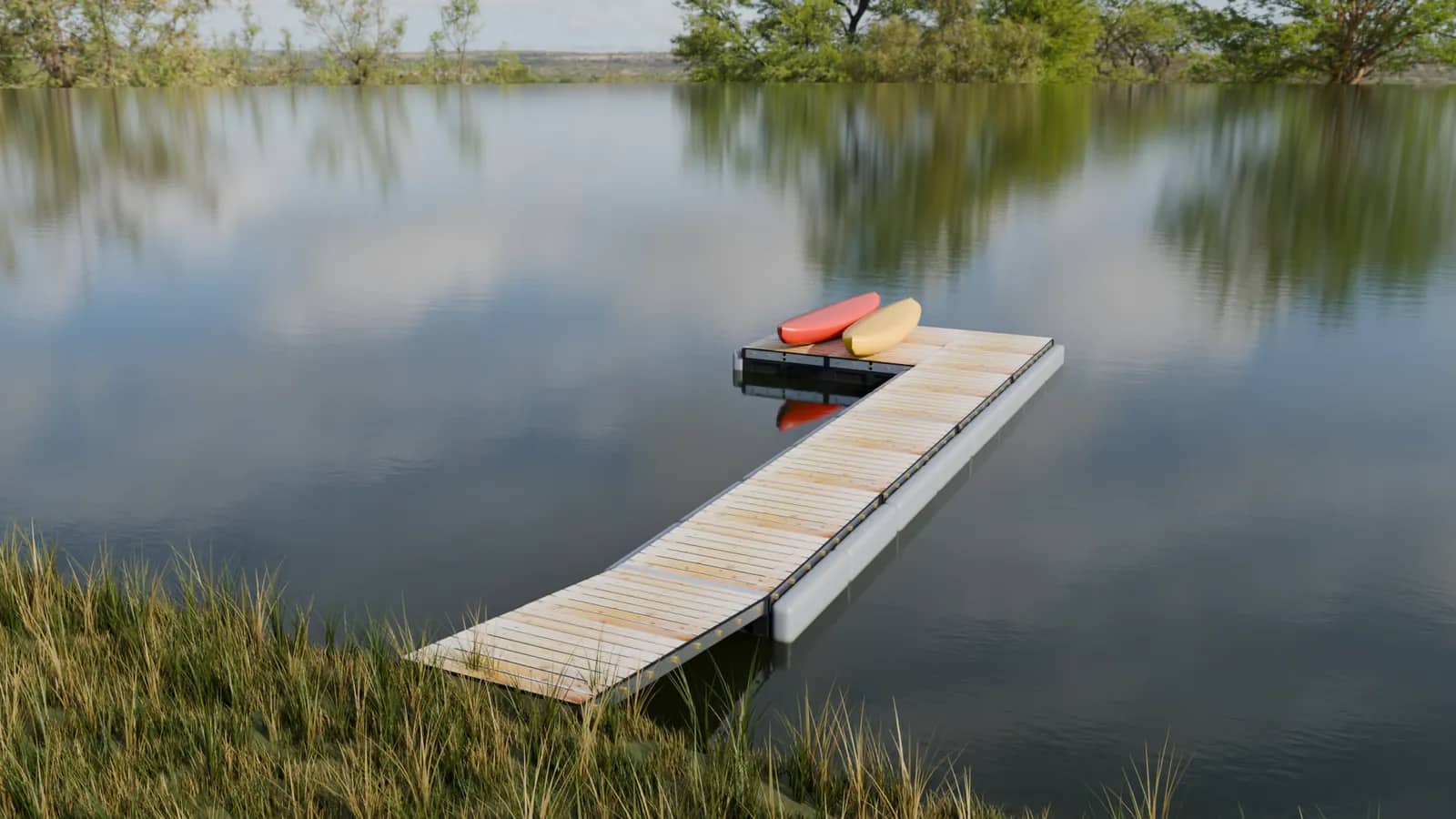
Plan a floating dock from your water, not from the catalog. Measure the depth along the dock's line at your lowest water: the first float needs at least 2 ft of water under it, which is about 2-1/2 ft on your measuring pole. Patriot floating kits run 16 to 64 ft in 8 ft steps, and that length includes the 8 ft shore ramp. The deck sits about a foot above the water, and the walkway is 4 ft wide. Premium kits add side floats that make the dock much harder to tip. For a boat, plan a stretch of dock at least two-thirds as long as the boat, in water deep enough for it. If your stock tank or pond is shallow, steady and firm on the bottom, a stationary kit can be the better buy.
- 2 ftof water under the first float at low water, about 2-1/2 ft on your pole
- 16 to 64 ftkit lengths, ramp included
- About 1 ftdeck height above the water
- 2/3of your boat's length, in water deep enough for it
Where do you start?
Two numbers drive every other choice: how deep the water is along the dock's line at its lowest, and how far the level moves through the year.
Measure at low water
Late summer, when Texas water sits lowest. Measure every 8 ft out along the dock's line with a marked pole, from a kayak, or by wading only where it's shallow. Measuring at another time of year? Subtract how far the water usually drops by late summer; you'll know from past years.
Check the bottom
Push a rod into it. Mud, sand, clay or rock decides your anchoring, and whether a stationary kit is an option.
Mark the high water
Note the highest water you have seen too. A tank that barely moves and a lake that drops several feet need different plans.
A bank that slopes gently needs a longer dock to reach depth; a steep drop-off needs less.
How high will the deck sit?
About a foot above the water on a Patriot floating kit, and it stays there as the level rises and falls.
- Empty: Patriot's instructions put the deck about 12 in above the water.
- Loaded: a 4 by 8 ft section settles about 1 in for every 83 lb. Patriot says one adult lowers it about 2-1/2 in, and three people with a cooler about 5 in more.
- What it holds: Patriot rates each float at 390 lb and puts a finished 8 ft section at about 150 lb, so a standard section has roughly 600 lb left for people and gear, about three people and a cooler. Treat that as its limit, and spread the load out. Patriot's 40 lb per square foot figure is the frame's rating; on the water the floats set the limit.
- Boats: pontoon decks ride roughly 12 to 20 in above the water, so stepping onto a pontoon is a short step up, and kayaks launch easily from a floating deck.
- Stationary kits stay at the height you set, and the water moves up and down instead.
How long should the dock be?
Long enough that the first float has at least 2 ft of water under it at your lowest level, plus room to tie a boat where the water is deep enough for it.
| Kit length | Floating sections | Typical use |
|---|---|---|
| 16 ft | 8 ft | Kayaks and a jon boat, where it's deep close to shore |
| 24 ft | 16 ft | A pontoon or bass boat up to about 24 ft, if it's deep enough along the dock |
| 32 ft | 24 ft | The same boats with more dock in deep water |
| 40 ft | 32 ft | Two boats, or deeper water farther out |
| 48 to 64 ft | 40 to 56 ft | Reaching depth across a long, shallow slope |
Every length includes the 8 ft ramp, and shaped kits put part of it into the platform at the end. Patriot doesn't rate these docks by boat size or weight; for anything bigger than a pontoon or bass boat, ask us.
The boat rule: plan a stretch of dock at least two-thirds as long as the boat, in water deep enough for it. Patriot puts the minimum at 2 to 3 ft, with 4 to 5 ft best. A 21 ft pontoon wants 14 to 16 ft of that, so count only the dock past the point where your water gets that deep.
Short docks bob more. A longer dock bridges several waves and stays steadier.
Which shape fits how you will use it?
The shape decides how much room you have at the end. All four come as standard or premium floating kits, and as jack or pipe stationary kits.
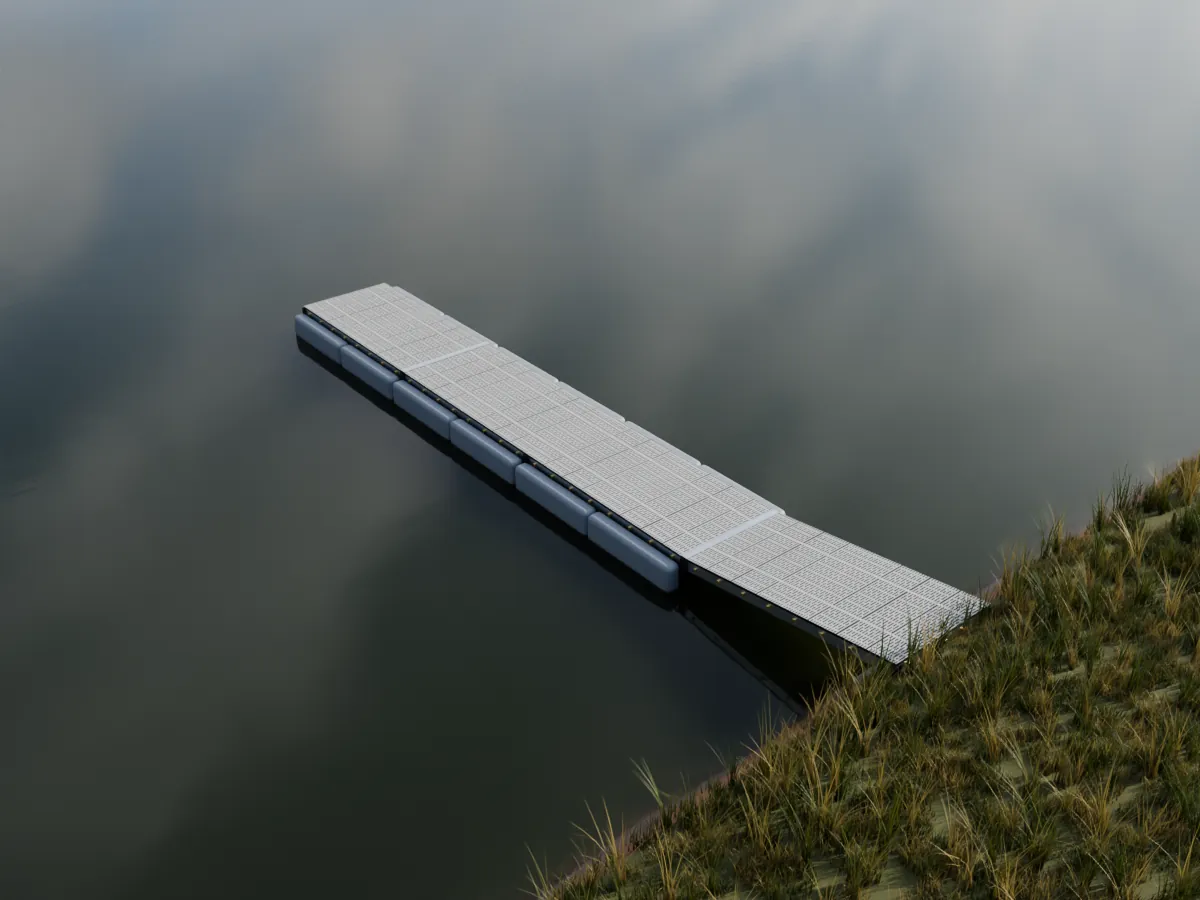
Straight
A 4 ft wide walkway. The simplest way to reach the water, with room to tie a boat along either side.
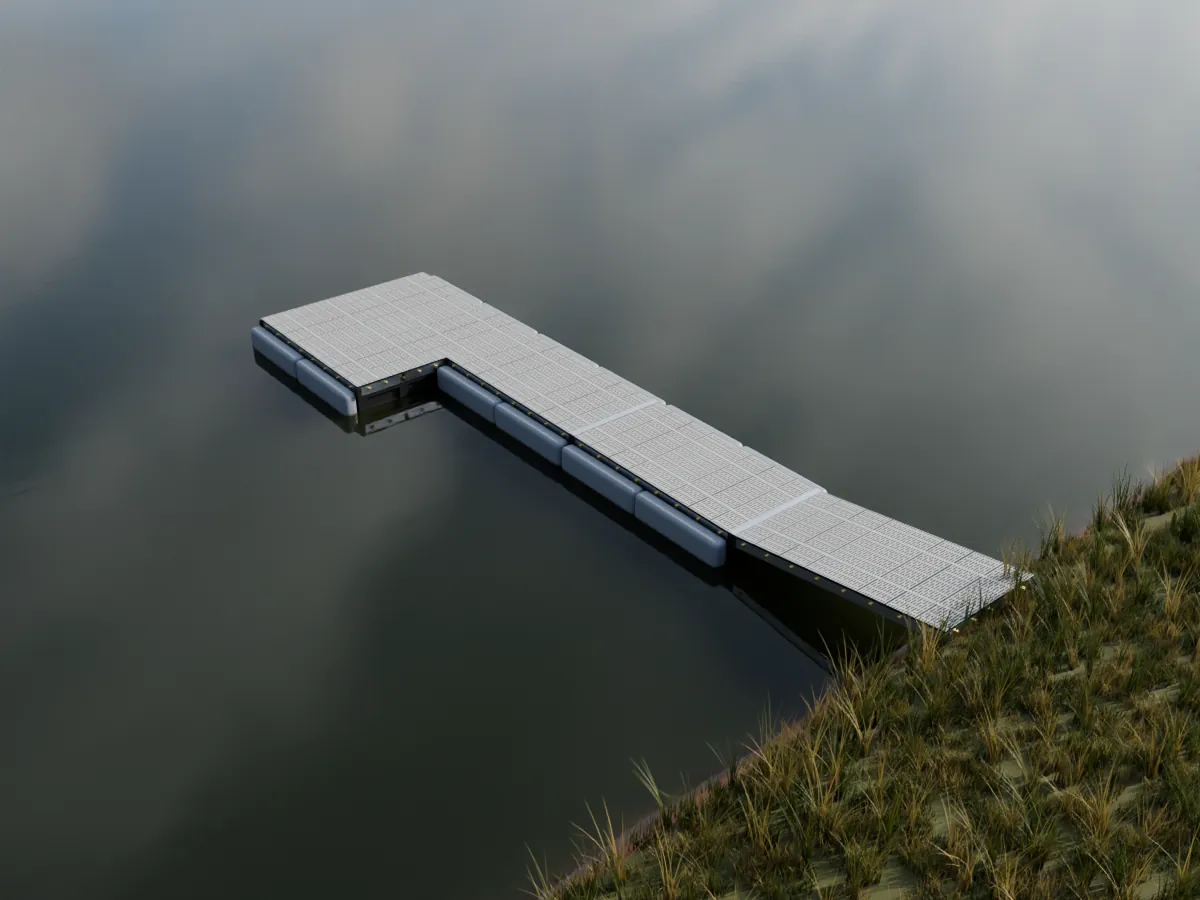
Patio
The last 8 ft is two frames wide: an 8 by 8 ft square to one side. Room for two chairs and a kayak launch.
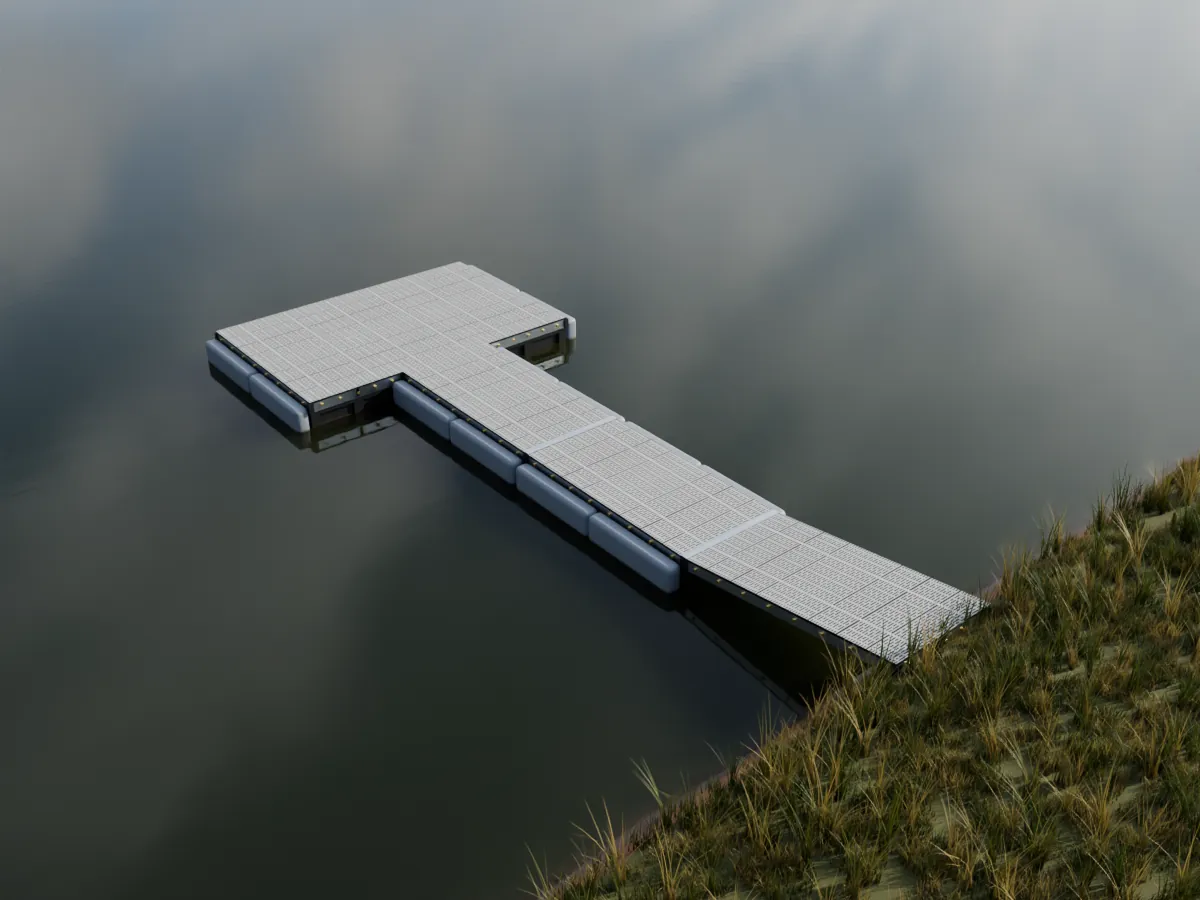
T-shaped
The last 8 ft is three frames wide: a 12 by 8 ft platform, centered. Room for the family.
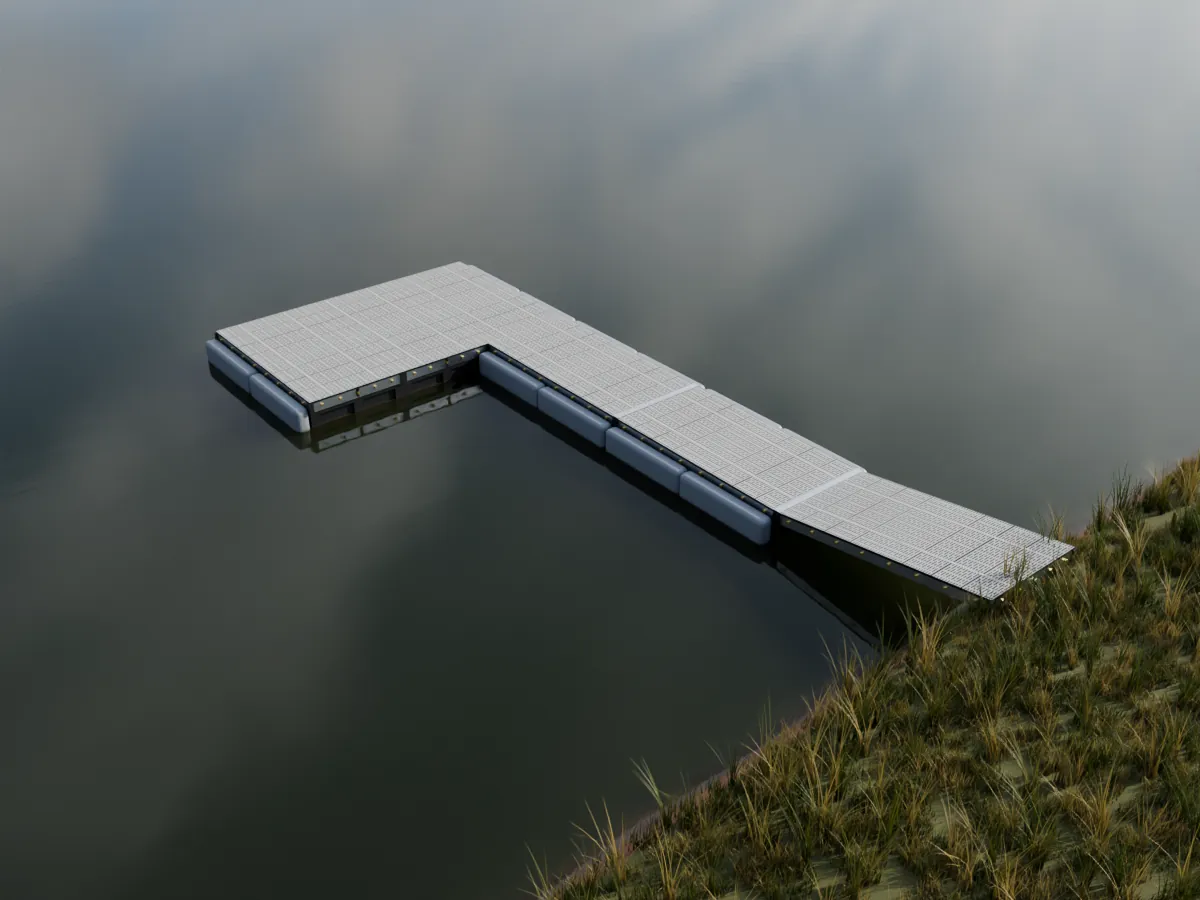
Double patio
The same 12 by 8 ft platform, set to one side. Patriot calls it the most stable layout.
Wide platforms catch more wind and waves, so they need more anchor points or heavier weights. See our anchoring guide.
Patriot's video guide
How do you get from the bank to the dock?
Every Patriot floating kit starts with an 8 ft ramp. How steep it is depends on how high your bank stands above the deck, and that changes as the water does.
Measure how high the bank is above the water where the ramp will sit. The deck rides about a foot above the water, so a bank about 2 ft above the water gives an easy slope of about 7 degrees, like a steep driveway. Each foot the water drops makes it steeper: about 15 degrees at 1 ft lower, a steep hill that's slick when wet, and about 30 degrees at 3 ft lower, as steep as stairs with no steps. Don't walk it at that angle.
The ramp's shore end stands on two short adjustable legs. If your water moves more than about 2 ft, or your bank stands high, Patriot suggests a longer gangway or a shore mount you can move, planned for low water. Talk to us before you order.
When is a stationary kit the better answer?
When the bottom is firm, the water is shallow at the dock's end, and the level holds steady.
Patriot's rule of thumb favors a stationary jack or pipe dock in water under about 6 to 8 ft at the end, with a firm bottom and steady levels. In steady water it stands on its legs with nothing to anchor, and Patriot says it usually costs less than a floating kit. Ask us which leg length your depth needs. See the stationary kits.
What does this look like on real Texas water?
Three common situations, and the kit we would start the conversation with.
A stock tank for fishing and kayaks
- The water
- Banks about 2 ft above the water, and 4 ft deep or more within 10 ft of shore even in August, when the level drops about a foot.
- Start with
- 24 ft patio floating kit, premium
- Why
- The ramp and 16 ft of dock reach good depth fast, the patio gives two chairs and a launch spot, and the side floats steady you while you fish from the edge. In August the ramp steepens to about 15 degrees. With 4 ft or more at the end, plan on chain and weights.
A lake lot with a 21 ft pontoon
- The water
- About 2-1/2 ft deep 8 ft out, then a gentle slope to 4 ft at 25 ft and 5 ft at 40 ft, at low water, and some boat wake.
- Start with
- 40 ft straight floating kit, premium
- Why
- The outer 16 ft sits in 4 to 5 ft of water, room to tie the pontoon along one side, and the side floats steady boarding. Plan on chain and weights, and check whether your lake needs a dock permit.
A shallow, steady cove
- The water
- Firm sand, about 2 to 3 ft deep, a level that barely moves.
- Start with
- Patio stationary jack kit
- Why
- Nothing to anchor in steady water, and the deck levels from the top with a drill.
Examples, not quotes. We confirm length, shape and anchoring for your shoreline.
Quick answers
How much water do I need under a floating dock?
At least 2 ft of water under the first float at the lowest level you expect, which is about 2-1/2 ft on a measuring pole. To tie up a boat, Patriot puts the minimum at 2 to 3 ft, with 4 to 5 ft best.
Does the kit length include the ramp?
Yes. Patriot counts the 8 ft shore ramp inside the length, so a 40 ft straight floating kit is an 8 ft ramp plus 32 ft of floating sections.
How much weight can a floating dock section hold?
Patriot rates each float at 390 lb and puts a finished 8 ft section at about 150 lb, so a standard section has roughly 600 lb left for people and gear. It settles about an inch for every 83 lb.
Is a premium floating kit worth it?
If people will stand along the edges, fish from the side, or board boats, yes. Its side floats make the dock about 6 ft wide at the waterline instead of 4 ft, which Patriot estimates makes it about 3-1/2 times harder to tip.
Can I add on to the dock later?
Yes. Every Patriot floating kit is built from the same 4 by 8 ft frame, and new frames bolt to Patriot frames of any age, usually at the shore end. That means moving the ramp and checking your anchors.
Sources
- Patriot Docks, Floating Dock Design: How to Plan the Right Size and Layout (Sep 2026)
- Patriot Docks, Floating Dock Assembly Instructions (2026)
- Patriot Docks, Shore Ramp Kit Instructions (2026)
- Patriot Docks product FAQ
Shoreline Products sells and supports Patriot Docks kits; Patriot Docks builds them. Figures attributed to Patriot come from its published instructions and articles.